

Building a Movement for Single Mom Organizing Power
With the 2026 and 2028 election cycles approaching — and the 2030 U.S. Census close behind — JP’s nationwide coalition of single mothers is poised to impact the American policy landscape.
I’m willing to stake my claim on this: There is no other demographic that holds the delicate balance of personal progress and generational shaping like single mothers. Alongside our children’s social, emotional, and physical well-being, we hold in tandem our own desires, hopes, and dreams. We embody the principles of democracy, even when its principles don’t work in our favor — because there is an innate belief that our work is not in vain. That’s just how we are. It’s how we’ve always been.
And it is our desire to see a better world for our children that levels the playing field, no matter the race, socioeconomic background, or geographical location. There is a shared stake that inherently connects us and transcends the demographic differences that often fracture coalitions. Jeremiah Program (JP)’s bet that single mothers are the right coalition to build a better nation is evident across 43 states, whether politically red, blue, or purple. Ideology alone can’t make that happen. It’s the power of motherhood and the belief in a different future.

for affordable child care policy in Austin, Texas.
You probably know Marisa. Maybe you are Marisa. She owns a small, ranch-style home in a neighborhood that sits on the cusp of suburban and urban life. Her two children, ages 7 and 13, attend the local public school. With 15 years of faithful service at her full-time job, she has supplemented her income through short-term gigs to create cash flow when needed. She votes, watches the news, talks to her elderly mother about what’s happening in the neighborhood. She is not waiting to be told what it takes to thrive in this world. She has known for a long time.
By every standard this country claims to value, Marisa should be on the path to economic freedom. She should feel the effects of policies that work. She is not disengaged. She is not uninformed. She is overextended because of a society that requires single mothers to split their attention in ways it was never designed to support. Every hour she gives to civic engagement is an hour taken from the job, the kids, the side hustle that keeps the lights on. Civic engagement, as it has been designed, was never built for her schedule, her budget, or her life.
Single motherhood is isolating, and isolation tricks you into thinking you must do everything yourself, problem-solve alone, and that your needs, desires, and hopes matter less than the humans you are raising. That’s not always true. But it can feel that way. And feelings are strong determinants of how we navigate the world and engage with others — including whether we believe our civic participation is worth the cost of showing up.
Those feelings of isolation — and the failure of social and policy systems to meet very real burdens — are part of what drove me to bring mothers together. When I founded and led The Current Project, a nonprofit built around and with Black single mothers, I knew through my lived experience and theirs that single mothers are not a problem this country needs to solve. Women like Marisa found solace in being able to bring their unique stories into a space intentionally designed for their thriving; the isolation they lived with was met with a community of single mothers who were willing to hold the pains and triumphs of another, an ecosystem of its own making. An ecosystem that produces and carries what our families, communities, and this democracy need to survive: sound judgment under pressure, long-horizon thinking, radical resourcefulness, and a generational investment in the future. We are not the exception. We are the proof of concept.
Single mothers comprise an ecosystem that produces and carries what our families, communities, and this democracy need to survive.
The Case for a Single-Mom Coalition
Take food security, for example. In 2025, the federal government quietly discontinued its annual food security survey — the only national tool we had to measure hunger in America. SNAP — the program that keeps food on the table for millions of single-mother households — was cut by nearly $187 billion over 10 years, the largest reduction in the program’s history.
The Child Tax Credit was expanded in the same bill, increasing the max benefit of $2,000 per child to $2,200. But for years, the income formula for this credit had already given more benefits to higher earners; the gap has simply widened. A single mother of two who earns $16,000 a year gets 15% of what she earns above $13,500, which comes to $2,025 total, about $1,013 per child. A married couple earning $400,000 never meets that formula at all. They get the full amount per child. With the extra $200 per child, the couple’s credit rises to $4,400. The single mother sees no additional benefit. Read that again. The stopgap for many families is to live in states still committed to maintaining access to the social safety net — a geographic lottery no one should have to win just to eat.
“Single mothers face multiple barriers to economic success, even under better economic and policy environments,” says Dr. Elaine Waxman, Senior Fellow at the Urban Institute. “Programs that provide critical support to families who don’t earn enough to make ends meet — like SNAP and Medicaid — are undergoing the most significant cuts since their creation. I think we can expect to see growing hardship in the next couple of years unless these dramatic policy changes are disrupted. And that hardship can translate into worse outcomes for children in both the near and long-term.”
What is clear is that changes to both SNAP and the Child Tax Credit were made without its primary beneficiaries at the table. What becomes possible when those most impacted are the ones setting and leading the agenda? That’s where JP’s bet on single moms comes in.
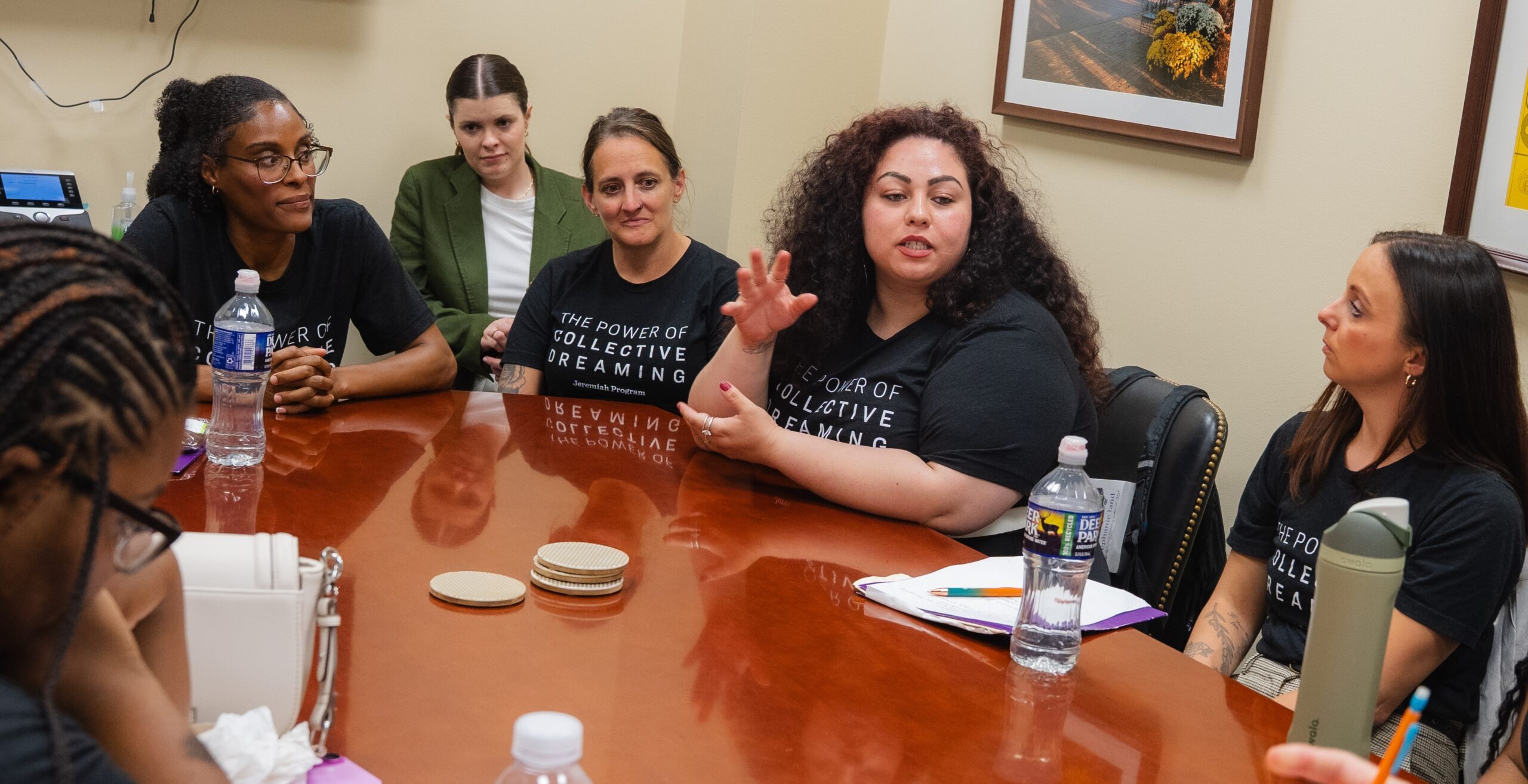
the needs of single-mother families.
What JP is building is a type of coalition. Their annual Summit Weekend — an in-person and virtual gathering with more than 2,500 single mothers nationwide in 2026 — is an incubator of sorts. Coalitions aren’t just mailing lists or databases of women who attended an event. They result when people with shared stakes and shared knowledge commit to moving together in one direction. In one year, JP’s virtual Summit attendance nearly quintupled. This growth isn’t because conditions for single mothers improved. As we know, they’ve gotten worse. The growth is the result of JP’s willingness to build the infrastructure to hold what was already there: an ecosystem of single mom power.
JP’s 2026 Urban Institute survey of nearly 1,800 mothers across 43 states found that shared conditions of housing hardship, food insecurity, and job disruption due to child care challenges revealed not just a shared condition but a shared policy agenda. This is what a coalition of single mothers makes possible: not just individual women voting but an organized constituency that tracks the same family and household metrics, holds the same systems accountable, and moves together when the policies that shape their lives come up for a vote.
States are taking on the majority of SNAP costs in October 2026, followed shortly by midterm elections. Federal elections are coming in 2028, with the next U.S. Census in 2030. Decisions that will affect families for the next decade and more are in motion right now, and single mothers and their families reside at each intersection. We are undoubtedly the most motivated civic force in this country, and, with partner organizations around the nation, JP is working to unify 30,000 of us by 2030.
This is the clearer signal of the potential JP is creating: JP is building the infrastructure to find Marisa wherever she is and a coalition worth bringing her into. Not a voter mobilization drive. Not a one-time convening. A sustained learning community designed to change how she understands her own civic power.
JP’s learning arc — book clubs, community conversations, Civic Engagement 101, a mom-centered GOTV effort that extends beyond Election Day — isn’t a voter mobilization curriculum. It becomes the place where single mothers can exercise the competencies we have already developed out of necessity — as negotiators, consultants, problem solvers, researchers, and advocates — and recognize their agency. Where most GOTV initiatives hand women information and ask them to show up, JP is doing something more intentional and sustainable: supporting women who understand themselves as power brokers in their own world. This is the infrastructure of a coalition identifying that, for single moms, a voting plan without child care isn’t a plan at all.
“Single mothers know exactly where the pain points are, but they are often told that these are the result of personal failings, rather than the result of intentional policy and economic choices.” – Dr. Elaine Waxman, Urban Institute Senior Fellow
Listen to Single Moms
“We have learned a great deal about how to reduce poverty, food insecurity, and other barriers,” Waxman says, “but we lack the political will to sustain those efforts. During the COVID-19 pandemic, policy responses like enhanced SNAP benefits, an expanded Child Tax Credit, and universal school meals brought food insecurity among households with children to its lowest level since we began tracking it in the late 1990s.”
As a country, we knew what worked. We chose not to sustain it.
“Single mothers know exactly where the pain points are,” Waxman adds, “but they are often told that these are the result of personal failings, rather than the result of intentional policy and economic choices.”
Her short answer: “Listen to single moms.”
Single moms have always known; our knowledge may not be found in policy briefs or research surveys, but it’s in the stories we’ve shared through the generations. Who knows systemic barriers better than the single moms who have lived it?
There is a saying within Black communities, born in jump rope rhymes and hand games, passed down by people who knew firsthand what it means to make something out of nothing: “trying to make a dollar out of 15 cents.” When I was in the thick of childrearing, I learned to make magic with what I had. We have praised single mothers for exactly this. We have made heroes out of their scarcity, celebrated their resilience as though the scraps were a gift rather than an indictment of what we refused to give.
What we are aiming for here is to make a dollar out of a dollar. This is not just an individual aspiration; it is a primary outcome of a coalition born of shared dreams. Economic mobility for one mother is meaningful. Economic mobility for a coalition of single mothers across race, geography, and political affiliation makes possible what has been deemed historically impossible. There is a generational advantage that belongs to all of us when we all can make it. When single mothers thrive, their children thrive. And when their children thrive, entire communities thrive. This is the outcome of organized, resourced, movement power — and it is what this country needs to allow itself to see and support.
Single mothers carry a burden of judgment often disguised as morality. But here is what I know to be true about that falsity and the reality beneath it: There is an unspoken fear that if single mothers coalesce our power, our voice, and the sheer determination that makes surviving single motherhood possible, those in power would be faced with their own hypocrisy. They would have to relinquish the fiction that we have no power. They would have to reckon with what was always true.
We were never powerless. We were never the problem. We were, and have always been, the proof of concept.
Alisha L. Gordon is a narrative strategist, essayist, and mother based in Harlem, New York. She writes at Honestly, Alisha on Substack.
30K Single Mothers by 2030
Over the next three years, the United States moves through three of the biggest civic windows before the decade turns: the 2026 midterms, the 2028 federal elections, and the 2030 U.S. Census. And in the fall of 2026, SNAP will experience serious funding reductions as the states take on the bulk of the cost.
Single-parent households now make up nearly 30% of American families, and more than 80% of those are led by single mothers, the majority of whom are SNAP recipients.
Organized and centered, that is a civic force large enough to help shape how the next decade of public policy and public investment get decided.
When you design policy that actually works for a single mom navigating child care, employment, and college simultaneously, you’ve built something that works for everyone. With 30,000 moms actively participating in civic processes like voting locally and federally — and completing the Census — that’s the kind of public policy we can influence.
That’s not a footnote. That’s a coalition — and one of the most underestimated, highly motivated civic forces in America.

Find this story and more in our magazine, Imagine!
When you design policies and structures that actually work for a single mom navigating child care, employment, and college simultaneously, you’ve built systems that work for everyone.
Those are the stories we’re telling in this fourth issue of Imagine.
Did this story resonate with you? A monthly gift goes further to support JP families.